
The three greatest tricks in magic.
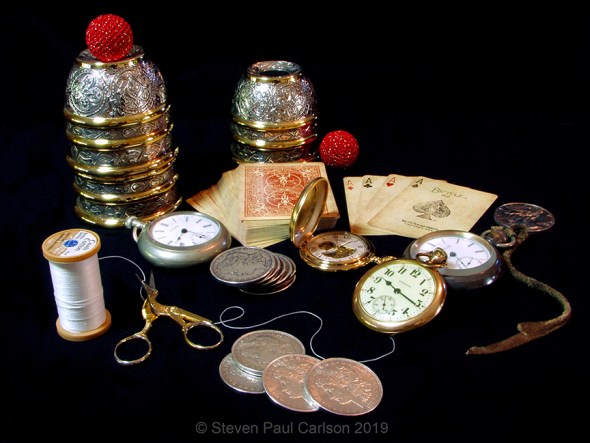
THE THREE GREATEST TRICKS IN MAGIC
© Steven Paul Carlson 2019
What are the three greatest tricks in magic?
That was the question posted by a magic acquaintance of mine.
It’s an intriguing question, and I will say a tricky one to answer as well 😦 Sorry about the pun! After 50+ years of professional magic experience, my hope here is to submit a response that is both informative and interesting to all readers, not just magicians.
The question was: What are the three greatest tricks in magic? I will, at the same time, take into consideration the three greatest effects in magic.
What is the difference?
In magic, the effect is what the trick is all about. For example, in a trick where a coin disappears from the magician’s hand, the effect is a vanish. A single trick usually has many methods that produce that effect.
Oftentimes, this magical effect appeals to a basic human desire or need. It is this effect on emotions that creates the magical effect’s powerful impact.
Counting down from # 3
3. Producing money from nowhere (The Misers Dream)
In the Miser’s Dream trick, the magician shows his hands empty, and his sleeves are rolled back. He then proceeds to pluck silver dollars out of thin air and drops them into a top hat or a wine bucket. This occurs as many times as the magician wishes. Often, he will walk into the audience and pull coins off people’s clothing. The coins are seen and heard as they drop into the hat or bucket. For a finale, the magician may produce a shower of coins from both hands.
This was a very popular trick in the 19th and early 20th century. Today, the value of a dollar coin has diminished greatly. However, in 1897, when T. Nelson Downs performed his Miser’s Dream on the Vaudeville stage, the purchasing power of a silver dollar was approximately $30. The average workman made $5 to $15 a week. So when the magician plucked a silver dollar out of the air, it was big money! That ability would truly be the dream of any member of the audience!
As a magician, I am often asked, “Can you turn a $1 into a $100?” That is one of those common, silly questions spectators like to ask magicians. The question does, however, reveal something valuable about how the audience’s mind thinks; if you really could do magic, wouldn’t you just magically make money appear?
The Miser’s Dream earns its place in the three greatest magic tricks because it appeals to this basic human dream, the ability to produce money out of nowhere!
3. The Floating Bill is tied for third
In the floating bill trick, paper currency is borrowed from the audience. The magician lays the bill upon his empty hands and gently crumbles it into a ball. The paper ball, lying upon the magician’s open palm, begins to rise up out of his hand. The magician waves his other hand over and under the floating ball to show that nothing is attached to it. The magician now gracefully waves both hands around the ball floating in mid-air. The magician then secures the bill between his fingers, unfolds it, and hands it back to the spectator.
Gravity, without doubt, is the first natural law or force of nature we become aware of… often with painful lessons. As a result, witnessing something float, unaided in space, is truly an impossible phenomenon. Because gravity is one of life’s most powerful realities, a levitation will always be disarming and stunning to behold.
In magic, we of course refer to this effect as a levitation or anti-gravity.
The Floating Bill earns its place in the top magical tricks of all time because it dramatically defies a fundamental force of nature. And it does so with a borrowed object, performed at a close-up range, under any conditions. It is truly impossible.
Additional note: In a list of the three greatest stage magic tricks, the levitation of a person would probably rank number 1 or 2.
2. The Cut & Restored Thread (Gypsy Thread)
In the Gypsy Thread trick, a 3’ length of common sewing thread is cut into 10-12 pieces. The pieces of thread, without ever leaving your sight, are instantly restored to their original, undamaged condition. In magic, the effect is called a restoration.
In life, we are constantly faced with disorder and destruction. Life itself is chaotic. And people, by nature, are compelled to find meaning and to bring order and restoration to this chaotic life.
Quite often, the plot of a magic trick (especially card magic) is creating order and restoration out of chaos.
This is where the Gypsy Thread trick is so powerful. Life all around us is vulnerable and fragile. The Gypsy Thread trick earns its place in the top three magic greats because it visually addresses that deep human desire… the ability to restore something that has been damaged or destroyed; to bring restoration and healing to chaos and destruction.
1. The Cups & Balls
Standing at number one is the ancient classic… The Cups & Balls.
The unique quality of the Cups & Balls trick is that it encompasses many different magical effects: the balls appear, vanish, penetrate, and move mysteriously from cup to cup or from hand to cup. The Cups and Balls grand finale always produces astonishing final productions under the cups, like large balls or fruit and vegetables, objects that barely fit into the cups. I personally produce a cupful of loose pennies.
One famous magician referred to the Cups and Balls as “the groundwork of all legerdemain.”
Throughout ancient history, many societies and cultures have created their own unique versions of the Cup or Bowl-and-Ball effect. India, China, and Japan each created their own versions. First century Romans called the Cups and Balls, “Acetabula et Calculi”, the vinegar cups and the pebbles.
The first written explanation of the Cups and Balls trick appeared in 1584 in a book called “The Discovery of Witchcraft.”
The Cups & Balls is certainly the oldest and most popular effect in the magician’s repertoire. At the same time, it is also the most exposed magic trick. Every beginner magic set comes with the familiar plastic blue, yellow, and red cups and the three little yellow pom-pom balls.
There was even a humorous attempt to “expose” this great classic on national TV using clear plastic cups.
In spite of all this, or maybe because of all this, the Cups & Balls have stood up to the hard test of time and remain a true classic in magic. To this day, the Cups & Balls continues to amaze and mystify audiences. And like the Phoenix, it rises from its ancient ashes to recreate itself for new generations in a world of advancing technology.
The Cups and Balls earns the top spot among the greatest magic tricks of all time because it enables us to experience a true sense of wonder and mystery. A moment when nothing is impossible. We are reminded that we, as human beings, not only want magic in our lives, but we need it. Even if it is only an illusion.
https://www.stevenpaulcarlson.com
© Steven Paul Carlson 2019
______________________________
Sleight of Hand Artist:

Sleight of Hand Artist Steven Carlson performing coin magic.
SLEIGHT OF HAND: The use of digital dexterity and cunning to deceive.
The sleight-of-hand artist relies on digital skills to perform his illusions. These techniques are invisible to the audience. The juggler openly displays his hard-earned skills. The sleight-of-hand artist hides them. They are concealed within natural movements and actions.
Beyond the finely acquired skills of his dexterous fingers, the sleight of hand artist also relies upon other subtleties to accomplish his deceptions: Psychology and timing, language, both verbal and physical, help him in deceiving all of the audience’s senses.
Sleight of hand is synonymous with the art of close-up magic. It’s a form of magic performed within close proximity to the audience. The objects used are common everyday items, playing cards, coins, paper currency, and even cell phones. Though anything that fits into the artist’s hands becomes magical. This impromptu style of close-range magic makes deception seem totally impossible, yet amazingly, the totally impossible still occurs.
Close up Magic, what is close up magic?
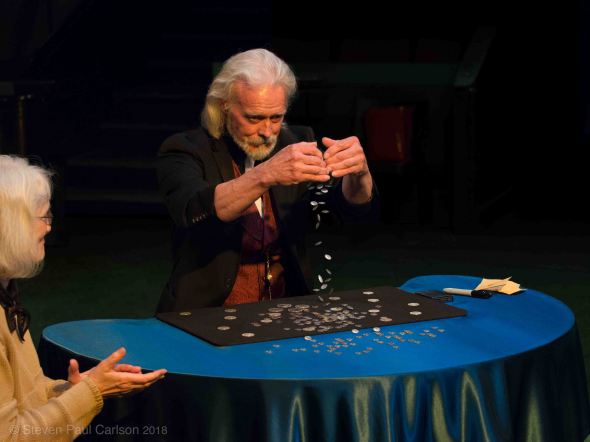
What is close-up magic? What is a close-up magician?
Close-up magic is the intimate art of producing astounding illusions by sleight of hand performed within close proximity to the audience.
The magical objects or props need to fit in the close-up magician’s hands. The traditional props are playing cards, coins, cups & balls, and even dice. However, anything that fits into the magician’s hands is fair game for his miracles: a cell phone, a pen, paper napkins, a saltshaker, a coffee cup, or a dollar bill.
Unlike the stage performer, the close-up artist brings his magic right into the audience space. There’s no stage or curtains, no boxes or mirrors, simply an object in the magician’s hands held inches away from the spectator’s eyes. The magic often happens right in the spectator’s hand!
Under these strict, close-up, and challenging conditions, deception seems utterly impossible. Yet, miraculously, the totally impossible still occurs! Close-up magic is by far the most demanding form of the magical arts, and when done perfectly, it is the most astounding!
Close-up magic is best performed for an audience of 30 or fewer and can be performed sitting at a table or standing. With the arrival of LSV (large-screen video) technology, larger groups can be accommodated.
Another form of close-up magic is strolling magic. This style has become popular for social and cocktail hours, where guests stand and mingle in small groups. The close-up magician moves around the room entertaining these smaller groups of guests. Street magic is also a form of close-up magic.
https://www.stevenpaulcarlson.com
Photo & art credits:
Photo art manipulation by Steven Paul Carlson, portrait photo by Nick Olson
Coin Magic: The Coin Magician’s Dream

The Coin Magician’s Dream, photo art by Steven Carlson
In the art of close-up-magic, coin magic easily finds its place toward the top of the most challenging skills.
Coins, along with playing cards, are the primary objects in the close-up magician’s repertoire.
Historically coins predate playing cards by a good three to four thousand years.
Coins were first introduced as a method of payment around the 6th or 5th century BC and have been in the magician’s bag of tricks ever since.
In the magician’s hands, coins appear, vanish, and multiply. They magically move from place to place or from hand to hand, visibly and invisibly. Coins change from silver to copper and even grow in size. The possibilities of magic with coins are limitless.
Coin magic relies on the artist’s intricate dexterity. Dexterous skills acquired through years of practice, training, and performance.
A master sleight-of-hand artist’s technique is never seen. To the audience, it is invisible. These graceful methodologies lie gently hidden beneath the surface of natural movements and gestures. Only then does the coin magic appear effortless and impossible.
My name is Steven Paul Carlson. I have been practicing magic since I was 6 years old, and I have been performing it professionally for over 55 years.
So sit back, relax, and enjoy the magical ride.
Oh, and please, fasten your seat belts. 😉
https://www.stevenpaulcarlson.com
Photo & art credits:
Coin and photo art by Steven Paul Carlson, portrait photo by Nick Olson
One Coin Magic
Elegant Coin Magic by Steven Paul Carlson
Magic with coins is my favorite expression within the performance art of Close-Up Magic. I have worked with this particular “One Coin” routine for approximately 35 years. A magical effect is never finished; it just keeps evolving and growing. I sincerely hope you enjoy it!
My thanks to the very talented Kevin MacLeod for creating the beautiful music and allowing me to use it here.
Music:
“Sardana” Kevin MacLeod (incompetech.com)
Licensed under Creative Commons: By Attribution 3.0
http://creativecommons.org/licenses/b…
© 2015 Steven Paul Carlson.
This video is copyrighted and may not be used without the written permission of Steven Paul Carlson


 art & magic