
The three greatest tricks in magic.
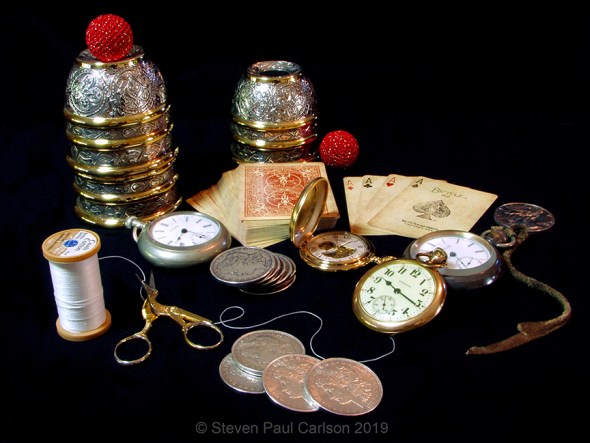
THE THREE GREATEST TRICKS IN MAGIC
© Steven Paul Carlson 2019
What are the three greatest tricks in magic?
That was the question posted by a magic acquaintance of mine.
It’s an intriguing question, and I will say a tricky one to answer as well 😦 Sorry about the pun! After 50+ years of professional magic experience, my hope here is to submit a response that is both informative and interesting to all readers, not just magicians.
The question was: What are the three greatest tricks in magic? I will, at the same time, take into consideration the three greatest effects in magic.
What is the difference?
In magic, the effect is what the trick is all about. For example, in a trick where a coin disappears from the magician’s hand, the effect is a vanish. A single trick usually has many methods that produce that effect.
Oftentimes, this magical effect appeals to a basic human desire or need. It is this effect on emotions that creates the magical effect’s powerful impact.
Counting down from # 3
3. Producing money from nowhere (The Misers Dream)
In the Miser’s Dream trick, the magician shows his hands empty, and his sleeves are rolled back. He then proceeds to pluck silver dollars out of thin air and drops them into a top hat or a wine bucket. This occurs as many times as the magician wishes. Often, he will walk into the audience and pull coins off people’s clothing. The coins are seen and heard as they drop into the hat or bucket. For a finale, the magician may produce a shower of coins from both hands.
This was a very popular trick in the 19th and early 20th century. Today, the value of a dollar coin has diminished greatly. However, in 1897, when T. Nelson Downs performed his Miser’s Dream on the Vaudeville stage, the purchasing power of a silver dollar was approximately $30. The average workman made $5 to $15 a week. So when the magician plucked a silver dollar out of the air, it was big money! That ability would truly be the dream of any member of the audience!
As a magician, I am often asked, “Can you turn a $1 into a $100?” That is one of those common, silly questions spectators like to ask magicians. The question does, however, reveal something valuable about how the audience’s mind thinks; if you really could do magic, wouldn’t you just magically make money appear?
The Miser’s Dream earns its place in the three greatest magic tricks because it appeals to this basic human dream, the ability to produce money out of nowhere!
3. The Floating Bill is tied for third
In the floating bill trick, paper currency is borrowed from the audience. The magician lays the bill upon his empty hands and gently crumbles it into a ball. The paper ball, lying upon the magician’s open palm, begins to rise up out of his hand. The magician waves his other hand over and under the floating ball to show that nothing is attached to it. The magician now gracefully waves both hands around the ball floating in mid-air. The magician then secures the bill between his fingers, unfolds it, and hands it back to the spectator.
Gravity, without doubt, is the first natural law or force of nature we become aware of… often with painful lessons. As a result, witnessing something float, unaided in space, is truly an impossible phenomenon. Because gravity is one of life’s most powerful realities, a levitation will always be disarming and stunning to behold.
In magic, we of course refer to this effect as a levitation or anti-gravity.
The Floating Bill earns its place in the top magical tricks of all time because it dramatically defies a fundamental force of nature. And it does so with a borrowed object, performed at a close-up range, under any conditions. It is truly impossible.
Additional note: In a list of the three greatest stage magic tricks, the levitation of a person would probably rank number 1 or 2.
2. The Cut & Restored Thread (Gypsy Thread)
In the Gypsy Thread trick, a 3’ length of common sewing thread is cut into 10-12 pieces. The pieces of thread, without ever leaving your sight, are instantly restored to their original, undamaged condition. In magic, the effect is called a restoration.
In life, we are constantly faced with disorder and destruction. Life itself is chaotic. And people, by nature, are compelled to find meaning and to bring order and restoration to this chaotic life.
Quite often, the plot of a magic trick (especially card magic) is creating order and restoration out of chaos.
This is where the Gypsy Thread trick is so powerful. Life all around us is vulnerable and fragile. The Gypsy Thread trick earns its place in the top three magic greats because it visually addresses that deep human desire… the ability to restore something that has been damaged or destroyed; to bring restoration and healing to chaos and destruction.
1. The Cups & Balls
Standing at number one is the ancient classic… The Cups & Balls.
The unique quality of the Cups & Balls trick is that it encompasses many different magical effects: the balls appear, vanish, penetrate, and move mysteriously from cup to cup or from hand to cup. The Cups and Balls grand finale always produces astonishing final productions under the cups, like large balls or fruit and vegetables, objects that barely fit into the cups. I personally produce a cupful of loose pennies.
One famous magician referred to the Cups and Balls as “the groundwork of all legerdemain.”
Throughout ancient history, many societies and cultures have created their own unique versions of the Cup or Bowl-and-Ball effect. India, China, and Japan each created their own versions. First century Romans called the Cups and Balls, “Acetabula et Calculi”, the vinegar cups and the pebbles.
The first written explanation of the Cups and Balls trick appeared in 1584 in a book called “The Discovery of Witchcraft.”
The Cups & Balls is certainly the oldest and most popular effect in the magician’s repertoire. At the same time, it is also the most exposed magic trick. Every beginner magic set comes with the familiar plastic blue, yellow, and red cups and the three little yellow pom-pom balls.
There was even a humorous attempt to “expose” this great classic on national TV using clear plastic cups.
In spite of all this, or maybe because of all this, the Cups & Balls have stood up to the hard test of time and remain a true classic in magic. To this day, the Cups & Balls continues to amaze and mystify audiences. And like the Phoenix, it rises from its ancient ashes to recreate itself for new generations in a world of advancing technology.
The Cups and Balls earns the top spot among the greatest magic tricks of all time because it enables us to experience a true sense of wonder and mystery. A moment when nothing is impossible. We are reminded that we, as human beings, not only want magic in our lives, but we need it. Even if it is only an illusion.
https://www.stevenpaulcarlson.com
© Steven Paul Carlson 2019
______________________________
Gladden’s Grand Slam, art by Steven Paul Carlson

Minneapolis, Minnesota, artist Steven Paul Carlson.
For most of my professional art career, starting in the early 1970’s and still going today, I have been an illustrator. This was one of my favorite commissions.
The Minnesota Twins’ 1st World Series Championship, 1987. Game 1, Saturday, October 17th, Dan Gladden hits a grand slam home run to cap off a seven-run fourth inning. –
Interesting note: The Twins came into the 1987 season number 13 out of the 14 American League teams.
This piece of art was done for the Twins and WCCO Radio for the 1988 baseball pocket schedule. It was truly one of those great art commissions for me.
Original art available at: https://www.legendarycreations.com https://www.stevenpaulcarlsonart.com
Canis Lupus, Wolf art by Steven Paul Carlson
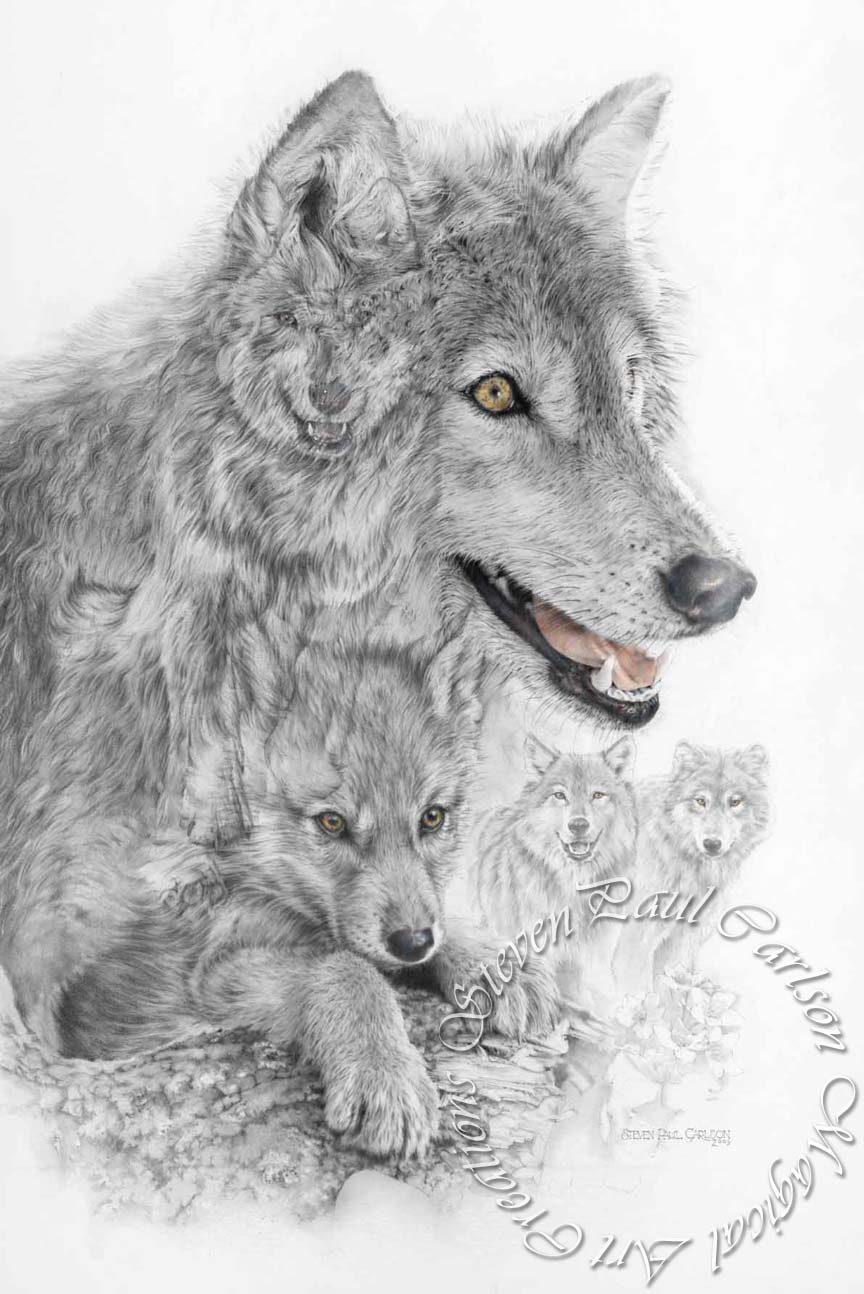
Canis Lupus V art by Minnesota artist Steven Paul Carlson
The Grey Wolf of the Americas – The Recovery
Historically, few animals have been as misunderstood as the wolf, and, as a result, it has been brought dangerously close to extinction. Because of the champion efforts of naturalists, wildlife advocates, and the support and financial contributions of wolf lovers, the tide is turning; the protection and recovery of the grey wolf population in America is proving very successful. I am proud that my home state of Minnesota has taken such a strong leadership role in these efforts!
Canis Lupus V is the new addition to the Hidden Creations Wolf series and is a celebration of the efforts of so many who have given so much of themselves to help in the recovery of the American grey wolf.
Graphite on board 20 x 32 by Steven Paul Carlson, hand colored Gicleé prints available at: https://www.legendarycreations.com https://www.stevenpaulcarlsonart.com
The Great Houdini, art by Steven Paul Carlson
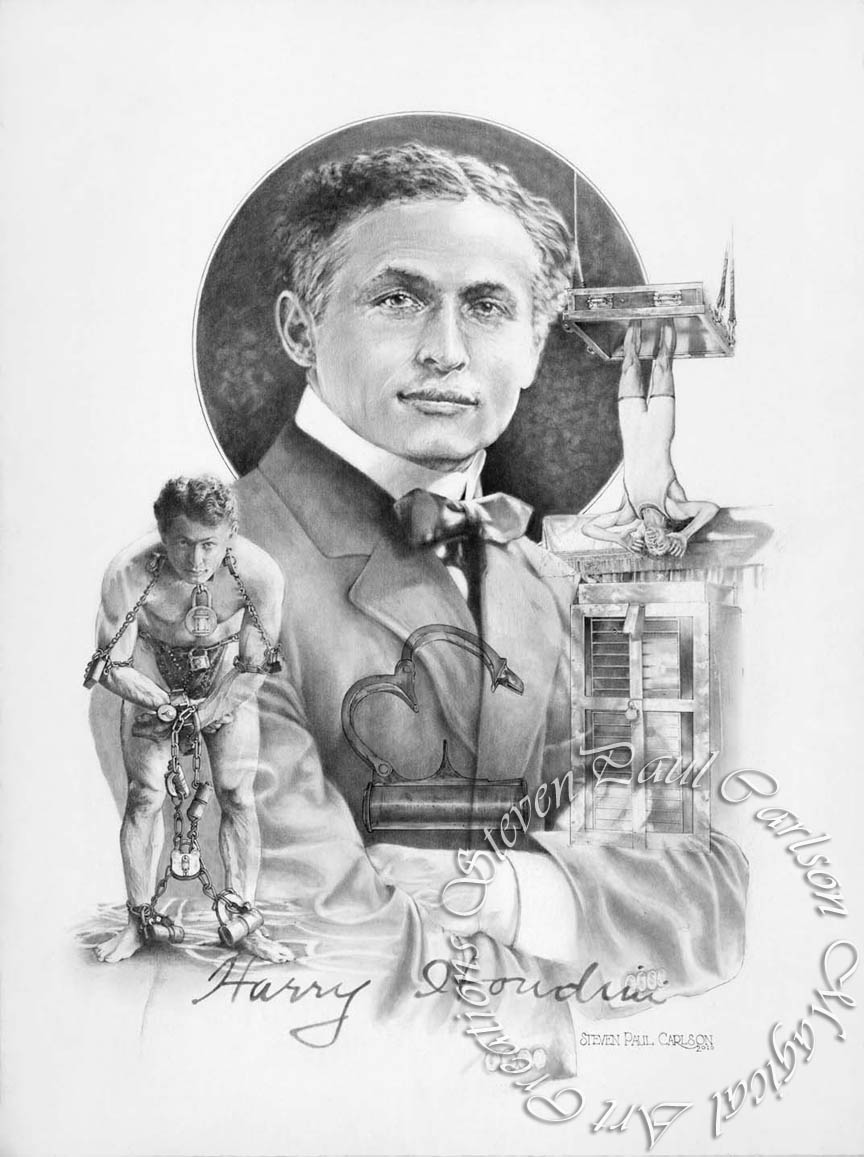
The Great Houdini, art by Steven Paul Carlson
(March 24, 1874 – October 31, 1926)
The center portrait was created from Houdini’s favorite publicity photo.
On the left, Houdini is performing his “challenge handcuff” act; it was in escapes, not magic, that Houdini would find his great success.
On the right is Houdini’s most famous escape, the Chinese Water Torture Cell. Houdini affectionately referred to it as The Upside Down. Contrary to common belief, Houdini did not die performing this act.
In the center are the Famous Mirror handcuffs, a custom set of cuffs made as a special challenge for Houdini by the London Daily Mirror in 1904. It was reported that 4000 people and more than 100 journalists turned out for the much-hyped event at London’s Hippodrome theater. The escape attempt dragged on for over three hours. When Houdini finally emerged free, he broke down and wept when he was paraded on the shoulders of the cheering crowd. Houdini later said it was the most difficult escape of his career.
Prints available at: https://www.legendarycreations.com https://www.stevenpaulcarlsonart.com
Harry Houdini, art by Steven Paul Carlson

Harry Houdini, art by Steven Paul Carlson
(March 24, 1874 – October 31, 1926)
Caught here in a rare moment of repose, Houdini was a Hungarian-American magician and escapologist, stunt performer, actor, and film producer. He was also a skeptic who set out to expose frauds purporting to be supernatural phenomena. For the majority of his career, Houdini performed his act as a headliner in vaudeville. For many years, he was the highest-paid performer in American vaudeville.
Born Erik Ivan Weisz (he would later spell his birth name as Ehrich Weiss) in Budapest, Hungary, on March 24, 1874, Houdini later claimed in interviews that he was born in Appleton, Wisconsin, on April 6, 1874.
His parents were Rabbi Mayer Samuel Weisz (1829 – 1892)
and his wife, Cecilia Steiner (1841 – 1913). Houdini was one of seven children.
Prints available at: https://www.legendarycreations.com https://www.stevenpaulcarlsonart.com
Buffalo Bill, portrait by Steven Paul Carlson
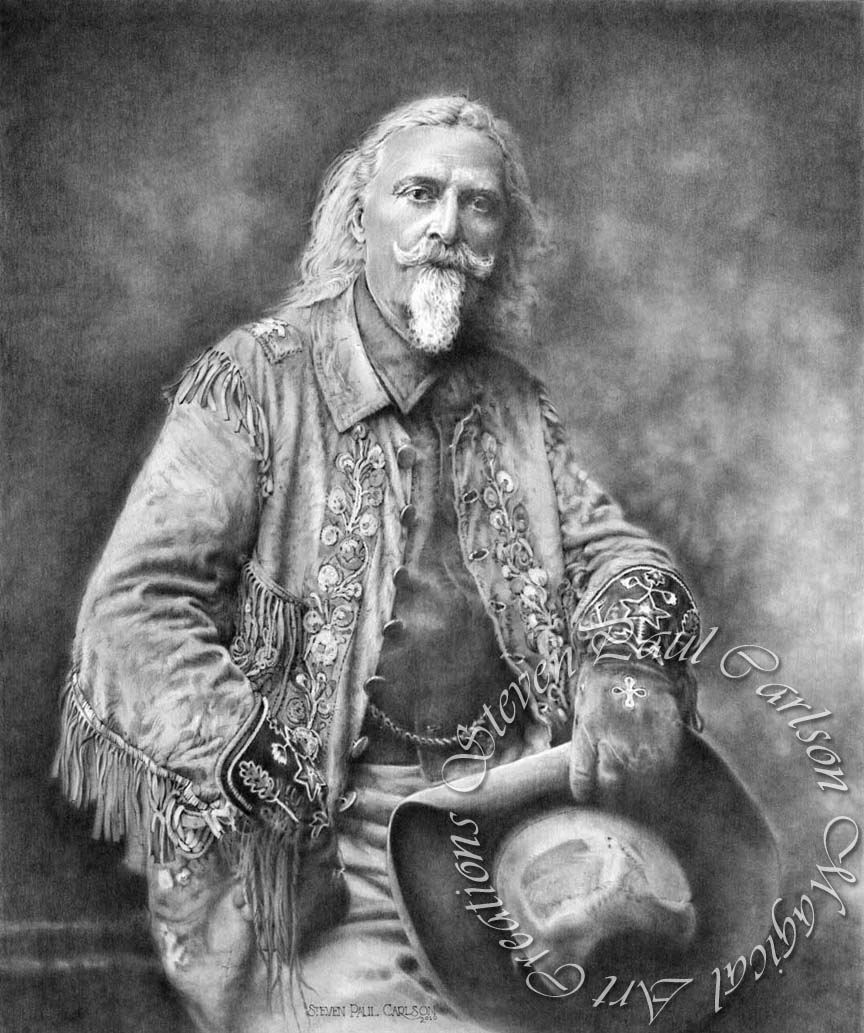
Buffalo Bill, portrait art by Minnesota artist Steven Paul Carlson
William Frederick “Buffalo Bill” Cody
(February 26, 1846 – January 10, 1917)
American soldier, bison hunter and showman Buffalo Bill was born in the Iowa Territory (now the American state of Iowa), near LeClaire. He was one of the most colorful figures of the American Old West, and mostly famous for the shows he organized with cowboy themes. Buffalo Bill received the Medal of Honor in 1872.
Prints available at: https://www.legendarycreations.com https://www.stevenpaulcarlsonart.com.


 art & magic